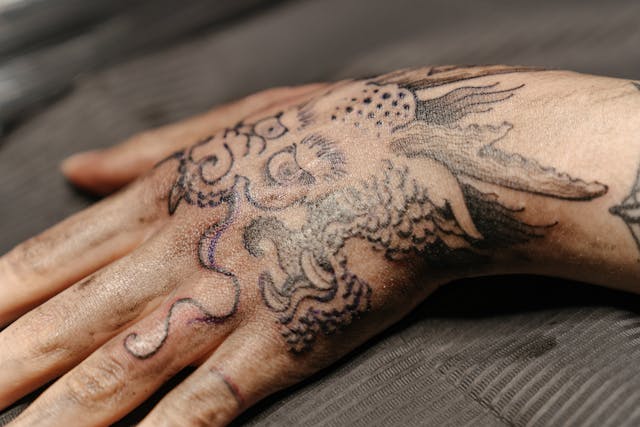
When tattoos fail its rarely down to bad luck being the issues, its the execution, it’s the design not being suitable for the areas it’s located in, it’s designs that maybe weren’t meant to go on skin and should have been for digital images only, or other mediums, or it’s simply not getting the right artist to complete the work.
In fact, there are multiple reasons why tattoos fail, and rarely is it not like these problems couldn’t have been caught prior to starting. Especially for people looking for more complex or custom designs.
Let’s take a closer look.
Trying to combine multiple concepts into one
This is one of the major ways things go wrong and fast. When someone wants a tattoo that pulls elements from three or four different ideas, like mechanical details, organic shapes, or something abstract layered over the top, for example, it all loses its shape and gets pushed into one composition.
And while it looks ambitious on paper, in reality, when it’s on skin, it can turn into conflict fast. There’s no focus, pulling elements together, or anything cohesive; just a lot of elements vying for attention, making the whole piece look sloppy. The thing with good tattoos is that they prioritise one idea, one style, and build around it, and everything else supports it; if it doesn’t, it doesn’t make the final version. If you want a tattoo that looks clean and you don’t feel the need to hide and cover up, working with a skilled custom tattoo artist will help you uncover what will and won’t work so you can avoid this mistake altogether.
Using reference images that rely on digital precision
Here’s the thing, a lot of people forget or overlook, not all digital images will transfer to skin properly. Or even paper for that matter. Digital art can be amazing and spark ideas for your tattoo; however, those perfect lines you’re coveting,g or the smooth gradients in the design, won’t always translate well to skin.
That’s not to say that you shouldn’t use digital art. You should, for inspiration only and build on it with your tattoo in mind. This means creating a custom design with the digital art as inspiration and a real experienced tattoo artist helping you adapt it to something that will still look amazing once ink hits skin.
Reducing complex designs to fit smaller tattoos or spaces
Complex designs that need to be shrunk won’t work. Some pieces need to be applied to a suitable space on the body for them to really shine. And if you’re trying to fit complexity into a smaller pace, things aren’t always going to come out the way you envision them, either.
What started out with clear lines when the ink was fresh will suddenly become blurred, gaps will disappear, and tight areas will close in if a design is dependent on the intricate details being followed closely then you need to give it the space to breathe as it settles on your skin.
Overusing fine line and soft shading without contrast
For the most part, this issue and others aren’t due to people not paying attention to the design; it’s about them not understanding what makes a good tattoo, and this is applicable to fine lines and shading. The design needs to rely on more than fine lines and soft shading. You need contrast to stop the design losing its shape; you need it to retain its individual construct and elements without them looking flat or blending together.
Strong, detailed work does not avoid fine lines. It balances them with enough built-in contrast so the structure still remains, as everything softens over time.
Skipping design revisions and approving too early
It can be really tempting to strike while the iron’s hot once your final design comes together, but it’s always best to take a step back. There should, especially for intricate or custom designs, be more than one draft; there needs to be changes, revisions, and a thoughtful process applied before committing to skin.
Work with your tattoo artist to understand how different parts of the tattoo will translate to skin, look for images of healed tattoos that are similar or have the same elements as what you want to have done, and see the final version. Then adjust, tweak, and make changes. Not all will work, but it will give you a better idea of what the final version needs to look like. It’s better to take time here rather than rush, so you end up with a perfect tattoo, not something you regret down the line.
Forcing symmetry onto areas that don’t support it
Symmetrical designs look great on flat surfaces. But the body isn’t flat, it curves, shifts,s and rarely mirrors perfectly from one side to the other, that’s natural, it’s not a fault on the part of your body.
But if you want to force symmetry somewhere it won’t exist naturally, you’re going to come across a problem fast. Over time one side will stretch more than the other, the lines won’t be along the way they should, or you wanted them too, and as your body changes and ages, es the differences will only become more noticeable. Good design work accounts for these variables in skin and on bodies, and a good artist will be able to adjust the design to ensure that, over time, these changes are built into the final version without ruining it completely.
Ignoring color shifts and variances
Color adds another layer of complexity to any tattoo. It will never stay exactly how it looks on day one. Color settles, softens, and sometimes it can blend lightly depending on how it’s packed and how closely colours sit together.
You need to know this and understand how color in tattoos works. You want something that looks good now and 10 years down the line. Talk with your tattoo artist about what to expect from the colors you want, how to approach the color in your tattoo, and what you need to avoid for great results.


Leave a Reply