Key Takeaways
- Simple, repeatable kitchen steps improve safety, quality, and speed.
- Prep plans reduce overproduction, shortages, and stressful decisions during service.
- Short checklists, labels, and timers reduce avoidable guesswork.
- Technology should solve a defined problem, not add another task for the team.
- Training is most effective when it reflects the work employees actually perform.
- New processes should be measured before being introduced across every location.
In a busy commercial kitchen, strong results come from repeatable routines rather than last-minute heroics. Clear workflows help teams protect food quality, move orders faster, reduce waste, and make each shift easier to manage. They also support upstream decisions, including how food contract packaging can help operators maintain product consistency, simplify portioning, and meet the practical needs of service.
Kitchen workflow improvement does not require a complete remodel or a fully automated operation. Often, the most useful changes are simple: a better prep sheet, a clearer label, a timer assigned to a specific task, or a training guide that employees can use during a rush. When those small improvements are followed every day, they create safer, more dependable operations.
Why Kitchen Workflows Matter More
Foodservice teams often manage a mix of dine-in service, takeout, delivery, catering, limited staffing, and menus with more customization. A weak process in one area can quickly affect the rest of the shift. For example, if the morning team does not label and stage lunch ingredients correctly, the line may run short during peak service, employees may open extra product unnecessarily, and guests may wait longer for orders.
Consistency matters because it connects food safety, labor use, cost control, and guest experience. A kitchen where employees know what to prep, where to store it, when to check it, and who owns the next step is easier to operate under pressure. Managers also gain a clearer picture of where delays, errors, and waste originate.
Start With a Workflow Check
Before purchasing equipment or adding software, study one real process from start to finish. Choose a high-volume activity, such as opening prep, cooling soup, labeling ready-to-eat ingredients, or completing closing sanitation duties.
- Write each step in the order it currently happens.
- Note where employees wait, walk too far, duplicate work, or need approval.
- Identify decisions that depend on memory instead of a written standard.
- Record common mistakes, such as missed temperature checks or unlabeled containers.
- Ask the employees performing the task which step creates the most frustration.
- Set one measurable goal, such as reducing prep time, waste, or missed checks.
A workflow review should focus on facts, not blame. If a task is routinely missed, the problem may be unclear ownership, poor placement of supplies, an unrealistic deadline, or a checklist that is too long to use during service.
Build a Clear Prep and Production Plan
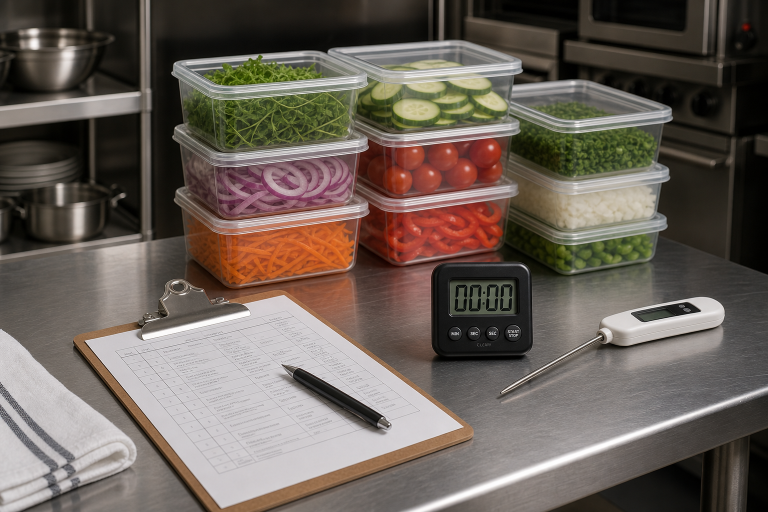
Prep plans should reflect actual sales patterns, available cold storage, staffing levels, delivery volume, and menu demand. Preparing everything at the start of the day may seem efficient, but it can create excess production and spoilage. Instead, use planned batch sizes that can be replenished as demand becomes clearer.
What Every Production Sheet Should Include
- Item name and recipe version
- Target quantity or batch size
- Prep deadline and employee assignment
- Portion or yield expectations
- Storage container, location, and handling instructions
For example, a high-volume café may bake a first batch of breakfast items before opening, prepare a second batch before the lunch rush, and hold back some production until sales confirm the need. Accurate recipes and portion tools make this approach more dependable because employees are not estimating quantities from memory.
Make Food Safety Steps Easy to Follow
Food safety tasks work best when they happen near the work they support. Keep thermometer access close to cooking and holding areas, provide label supplies at prep stations, and place cleaning tools where employees need them. Teams should not have to search for the right form or walk across the kitchen to complete a basic safety task.
Short, action-based checklists are more useful than vague forms. “Check cold holding temperature and record the result” is clearer than “Inspect refrigeration.” Kitchen leaders should also establish procedures that fit local requirements, using the FDA retail food protection guidance as a practical reference point for topics such as cooling, temperature control, and employee food safety education.
Digital logs and connected temperature tools can make records easier to review, but they do not replace management. Someone still needs to respond when a reading is out of range, a cooling check is incomplete, or a recurring sanitation issue appears.
Use Labels and Timers to Reduce Guesswork
A label should give the next employee enough information to handle the product correctly. Depending on the operation, that may include the product name, preparation date, discard or use-by date, employee initials, allergen details, and storage instructions. Use the same label placement across the kitchen so employees know where to look.
Timers should be named for the task they control, such as “chicken cook,” “rice cooling,” “soup hot hold,” or “salad freshness.” This removes uncertainty when several alarms sound at once. Clear timing and storage practices also support the safe handling principles outlined in Food Safety Basics for Cooling and Refrigeration.
Choose Automation That Solves a Real Problem
Automation does not have to mean a robotic kitchen. A targeted tool might print consistent labels, track cooler temperatures, forecast prep levels, dispense portions, or prompt employees to complete a recurring task. The best option is the one that removes repetitive work without creating a new burden.
Define the operational problem first. If employees are making label errors, start with a labeling solution rather than purchasing broad software that the team will not use. If breakfast orders bottleneck at one station, examine equipment placement, batch timing, and menu setup before assuming that more technology is the answer.
Train Staff Around the Actual Shift
Training should follow the rhythm of the kitchen: opening, prep, service, cleaning, and closing. Use demonstrations, photos, and brief practice sessions alongside written instructions. New employees need a simple, quick-reference guide for frequent tasks, including how to label products, respond to timer alerts, store ingredients, and report equipment issues.
Refresh training after menu changes, new equipment, or repeated mistakes. Employee feedback is especially valuable because line cooks, dish staff, and prep teams often see workflow obstacles before managers do.
Keep Workflows Consistent Across Locations
Multi-unit operators should standardize the essentials: recipes, labels, checklists, training materials, quality expectations, and reporting methods. Local conditions may require adjustments for layout, staffing, delivery volume, or health department requirements, but the underlying standard should remain recognizable from one site to the next.
Centralized updates help prevent outdated recipes and procedures from remaining in use. They also make onboarding easier and give managers a more meaningful way to compare performance across restaurants, schools, hospitals, catering kitchens, and other foodservice settings.
Measure Results Before Expanding
- Speed: Compare the task completion time before and after the change.
- Accuracy: Track incorrect labels, recipes, temperatures, and orders.
- Waste: Measure overproduction, spoilage, and discarded product.
- Training: Note whether new employees need less hands-on assistance.
- Safety: Review whether required checks are completed on time.
- Staff experience: Ask whether the process reduces confusion during peak periods.
A Simple 30-Day Workflow Plan
- Days 1 to 5: Document one current workflow.
- Days 6 to 10: Remove unnecessary steps and assign clear ownership.
- Days 11 to 15: Test the revised process during quiet and busy periods.
- Days 16 to 20: Train the full team and gather feedback.
- Days 21 to 25: Review speed, errors, waste, and completion rates.
- Days 26 to 30: Adjust the process and decide whether to expand it.
Common Mistakes to Avoid
- Creating checklists with too many steps to be practical.
- Buying technology before identifying the operational need.
- Training once without providing refreshers or feedback.
- Collecting data but failing to act on repeated issues.
- Copying one location’s process without testing local conditions.
- Ignoring equipment placement, cleaning needs, connectivity, and backup procedures.
Final Thoughts
Strong foodservice workflows are clear, repeatable, and easy to verify during a busy shift. The most effective improvements usually begin with one real problem, not a dramatic overhaul. Better prep planning, clearer labels, focused training, timely temperature checks, and useful technology can each make a meaningful difference when employees can apply them consistently every day.




Leave a Reply