Key Takeaways
A hospital payment demand and a workers’ compensation lien can arise from the same injury, but they do not come from the same Arizona statute.
In a third-party case, the source of every claimed deduction matters as much as the dollar amount.
Arizona’s health care provider lien statutes contain an express workers’ compensation exemption, so labels alone do not answer whether a claimed lien applies.
A workers’ compensation carrier’s lien may be tied to benefits it paid when an injured employee recovers from a negligent third party.
A clear settlement statement should identify the claimant, legal basis, payment history, proposed reduction, and final amount for each demand.
A work injury can create more than one file, more than one insurer, and more than one request for settlement money. A delivery driver injured in Phoenix traffic, a construction worker hurt by an outside contractor in Tucson, or a warehouse employee struck by a third-party vehicle may have both a workers’ compensation claim and a separate claim against someone other than the employer. Understanding how hospital liens differ from comp liens is essential before treating every medical deduction as interchangeable.
The practical problem is not simply that two statutes exist. It is that a single settlement can attract bills, reimbursement demands, releases, and lien notices that use similar language while serving different purposes. Arizona claimants should separate those demands early, particularly when a settlement is being negotiated after medical care has already been paid in whole or in part by workers’ compensation.
Why the Statutes Must Be Kept Separate
A hospital or health care provider lien is generally addressed in Arizona Revised Statutes Title 33. A workers’ compensation carrier lien in a third-party recovery is addressed in Title 23. Those separate statutory paths matter because the claimed right to payment, the funds at issue, and the paperwork supporting the request may differ.
Arizona’s health care provider lien article includes a provision stating that the article does not apply to accidents or injuries within the state workers’ compensation law. The text of the workers’ compensation exemption should be part of any review when a hospital lien is asserted in connection with an industrial injury. That does not mean an unpaid medical balance, a signed agreement, or a separate dispute disappears. It means the legal basis of the demand must be identified rather than assumed.
Workers’ compensation creates a different issue when another person or business may be responsible for the injury. If an employee pursues a third-party claim, Arizona law provides a lien to the carrier or other party liable for the workers’ compensation claim for compensation and medical, surgical, and hospital benefits paid. The statute measures the “amount actually collectable” after reasonable and necessary recovery expenses, including attorney fees actually spent to obtain the recovery.
Consider an Arizona employee who is injured when a non-employer driver runs a red light. The employee may receive emergency treatment, miss work, open a workers’ compensation claim, and later pursue a liability claim against the driver. By settlement time, the file may contain several distinct entries:
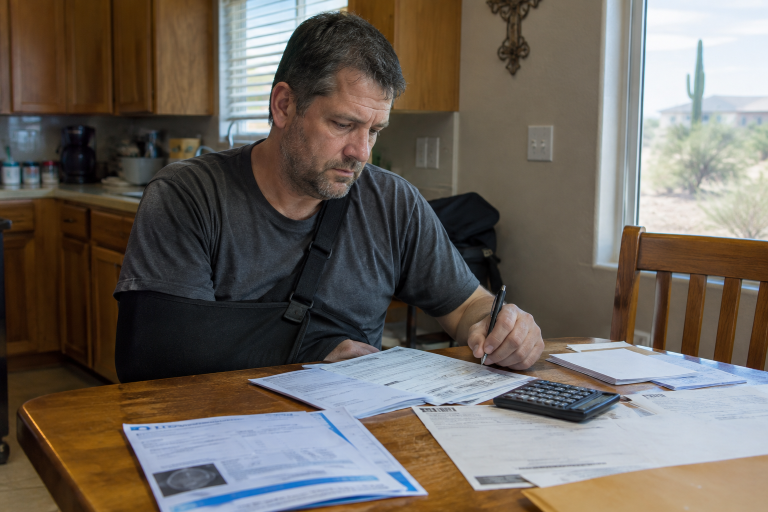
An emergency department account balance or itemized hospital bill.
A workers’ compensation carrier ledger showing medical and wage-replacement benefits paid.
A provider request for payment based on an alleged lien, contract, or remaining patient responsibility.
A third-party settlement offer and proposed distribution statement.
Attorney fees and case expenses related to obtaining the third-party recovery.
These records should not be collapsed into one line marked “medical liens.” A hospital invoice is not automatically a perfected statutory lien. A comp carrier’s reimbursement request is not automatically the same as a provider’s balance. And a charge appearing on a medical ledger may already have been paid, adjusted, denied, disputed, or included in another demand.
Start With a Settlement Statement Checkup
Before approving a distribution, ask for a written accounting that traces the money from the gross settlement to the expected net recovery. The statement should list each item separately and show the math.
The gross settlement amount.
Attorney fees, if applicable.
Case costs and litigation expenses.
The workers’ compensation lien claimed, with an itemized payment ledger.
Each hospital, clinic, ambulance, or other provider demand.
Any proposed reduction or compromise.
The amount held back for an unresolved issue, if any.
The final amount expected to be distributed to the injured worker.
For example, a $100,000 third-party settlement is not necessarily a $100,000 payment to the injured worker. Fees, costs, and valid claims may reduce the distribution. But the reverse is equally important: a large payment demand does not establish that the whole amount should be deducted. The settlement statement should show why the amount is claimed and whether it has been verified.
Compare Bills With Actual Payments
Arizona’s heat, long commutes, busy worksites, and high-traffic corridors can turn an unexpected injury into immediate emergency care. In that fast-moving period, billing records may lag behind claim payments. A hospital account may show a gross charge while the workers’ compensation carrier’s records show a later payment, adjustment, or denial.
Review the following documents side by side:
Itemized provider bills showing dates of service and treatment.
Workers’ compensation benefit and medical-payment ledgers.
Explanation of benefits forms, when applicable.
Any recorded lien notice or written payment demand.
Correspondence confirming a negotiated reduction or release.
If the same emergency-room visit appears on both a hospital demand and a comp carrier ledger, request clarification before money is distributed. The key questions are whether the provider was paid, whether a balance remains, and whether the demand rests on a valid legal or contractual basis independent of a payment already made.
Questions That Prevent “Zero Coordination” Problems
Settlement pressure can make vague answers feel sufficient. They are not. A claimant should be able to ask direct questions and receive records that match the proposed deductions.
Who is requesting payment from the settlement?
Is the request based on a statute, a contract, an assignment, or an unpaid account balance?
Which specific benefits or dates of service are included?
Has workers’ compensation already paid any part of the charge?
Does the claimed comp lien include only benefits connected to the third-party injury?
Are attorney fees and costs reflected in the calculation where Arizona law requires them to be considered?
Has the claimant agreed in writing to a reduced amount or release?
Will any issue remain unresolved after settlement?
Read the Release and Distribution Together
A release answers different questions than a billing statement. It may address claims against the third party, while separate language may address future medical care, unpaid balances, benefit rights, or settlement authority. Reading only the settlement number can leave important obligations unclear.
Workers can use the Industrial Commission of Arizona’s injured worker information to locate claim forms and workers’ compensation resources, but a claim portal or benefits record should not substitute for reviewing the settlement documents themselves. When multiple parties seek money, the release, lien materials, and final distribution should tell one consistent story.
Conclusion
Hospital liens and comp liens may appear in the same settlement conversation, but Arizona law does not treat them as one generic medical deduction. Separating the statute, claimant, payment history, and supporting records helps expose duplicate charges, unclear balances, and unsupported assumptions. The goal is straightforward: every dollar leaving a settlement should have an identifiable recipient, a documented reason, and math that can be checked before the papers are signed.





Leave a Reply